
I love digging into fictional worlds. I hate spoilers. And I’m always slightly afraid of stumbling into one.
Usually, I finish the game, watch the last episode, close the book or manga, and then open ChatGPT and unleash a whole pile of questions.
Questions about a character’s powers, a suspicious line in an item description, someone in an opening cinematic who never seemed to show up again. The kinds of things that sit in the back of your head until you absolutely have to talk them through with someone.
A few of my questions (story spoilers inside)
- “Why did Rika in Jujutsu Kaisen start eating body parts to copy powers? She didn’t eat anything to do that in the movie?!”
- “This spell description says Marika came from another world! So were the Erdtree and the Golden Order established through conquest?”
- “Who was that Gollum-looking figure among the first beings to find the great fire in the Dark Souls opening? Where is he? What is he?”
- “Wait, so Bran in Game of Thrones was taking over someone else’s body against their will?!”
With FromSoftware games, I started doing something a little different. I explicitly asked the AI not to spoil anything and kept talking to it as I played. I wanted help understanding what I’d already seen, picking up on details, and not walking straight past an entire NPC storyline.
Those games are what eventually pushed me to build TraceLore.
I want to understand the world I’m exploring
I love complicated, carefully thought-out worlds. But sometimes, to put the whole picture together, you practically have to live in one for months. And as much as I’d enjoy that, fitting it comfortably into everyday life isn’t always possible.
I also know plenty of people who love the same worlds but find it difficult to piece everything together. So they watch hour-long videos explaining the plot.
I get it. There’s a lot to keep in your head: names, factions, events, unreliable accounts, and some tiny detail from an item description you read twelve hours ago.
I wanted exploring all of that to feel convenient and modern.
And there was an experiment I couldn’t resist. If an AI could already help me through Elden Ring in a chat, keeping track of details and NPCs, could it research a whole game, build a wiki, and organize the information into spoiler levels?
I’m not particularly fond of the usual wiki experience: ads everywhere, and a major revelation sitting one sentence away from the answer you actually came for.
I wanted somewhere I could follow my curiosity without constantly bracing for that.
Deadlock was my first test
I pointed the agent at Deadlock first. When I started, it felt like a manageable world to try this with: one game and three visual novels, with plenty of material already online and carefully broken down across community wikis.
The result was surprisingly good.
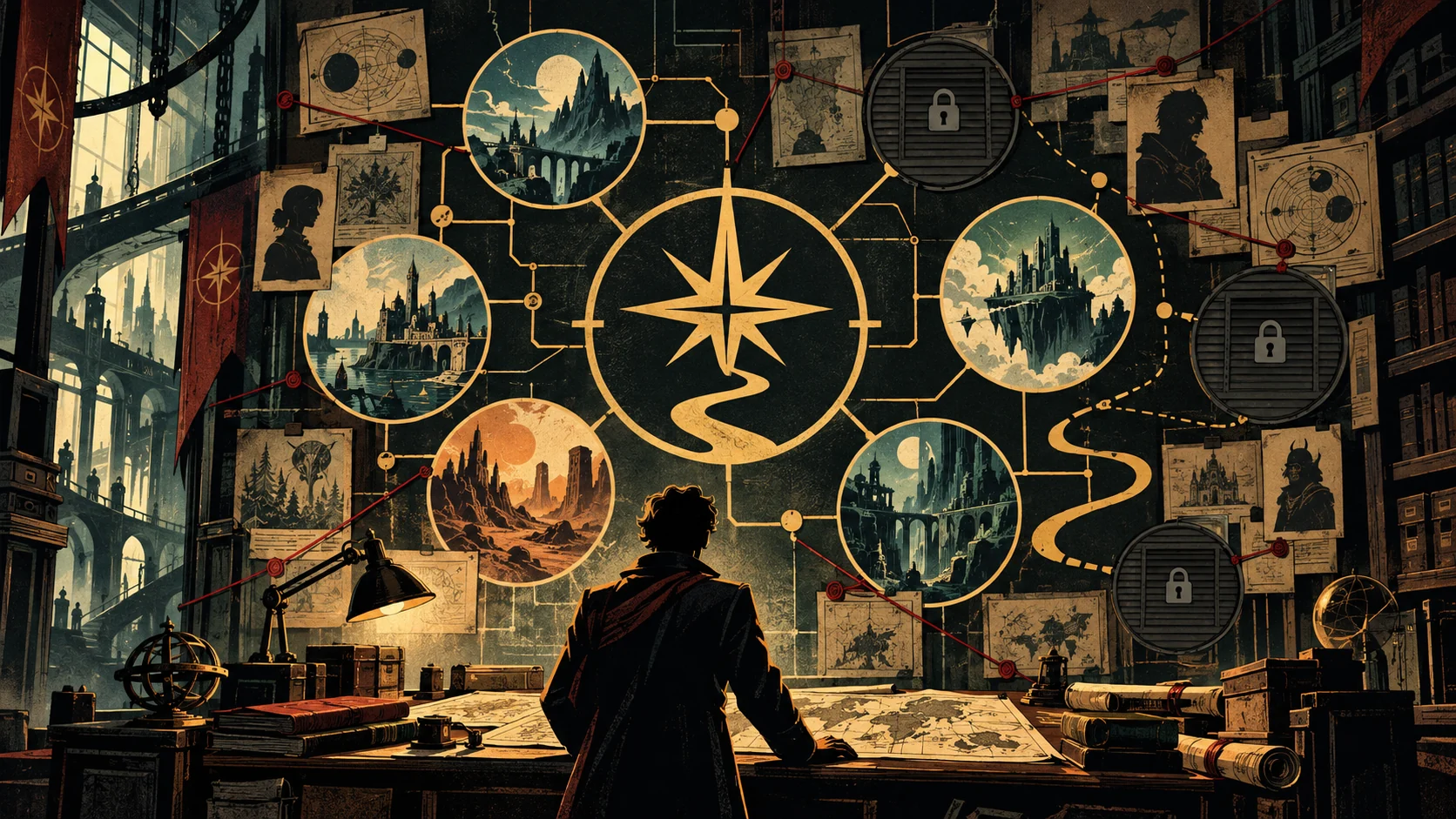
After the initial research, I asked the agent to build connections and a relationship graph: who is related to whom, who works for whom, who talks about whom, and so on.
Now I can open a character or an item and follow its connections. Having those threads laid out where I can actually explore them is incredibly practical.
I also added a dialogue player so I could listen to the characters talking to each other.
A very low bow to Valve and their voice work here. The amount of character in those conversations is ridiculous. My daughter and I love Rem, and we often quote him when we’re out walking:
“You have a hat and I have a hat - we hat brothers!”
But Deadlock wasn’t testing the part I cared about most. That archive had no spoiler protection.
So I moved on to Elden Ring and Dark Souls.
Then came the enormous problem: spoilers
This is where my agent spent a good day looking considerably less cheerful, pulling dialogue, descriptions, images, and other material from around the internet.
And gathering the material was only part of the work. The really enormous problem was deciding what you should be allowed to see, and when.
The default I’m building toward is spoiler protection, with exceptions for worlds that don’t need it and articles you deliberately open from an outside link. Deadlock remains an open archive. The protected worlds are still a work in progress.
I want a world to open up gradually, in layers.
You enter a location. Meet an NPC. Find their quest line in TraceLore. If you want a little help, you can look up the next step. Or you can read about the person you just met, why they are the way they are, and what on earth that order they keep mentioning is.
All of that should depend on how far you’ve actually got, rather than assuming you’ve already finished the game.
A TV series makes the idea much easier to describe: tell the service which episode you’re on, and it can show you the information revealed up to that point.
With a game, your route through the world can be much less predictable. That’s where things get interesting. And difficult.
There’s still a lot I want to build
This is far from finished.
I want a better way to tell TraceLore about my current progress. I’d like to add an MCP integration or an add-on so I don’t have to keep updating it by hand. Support for multiple languages is on the list too.
But I’m really enjoying the process. Every problem I run into makes me want to understand it properly and think through how it should work.
I started with a habit of asking an AI far too many questions about fictional worlds. Now I’m trying to give that curiosity a home.
You can explore the current version at tracelore.h3lpkey.com.