
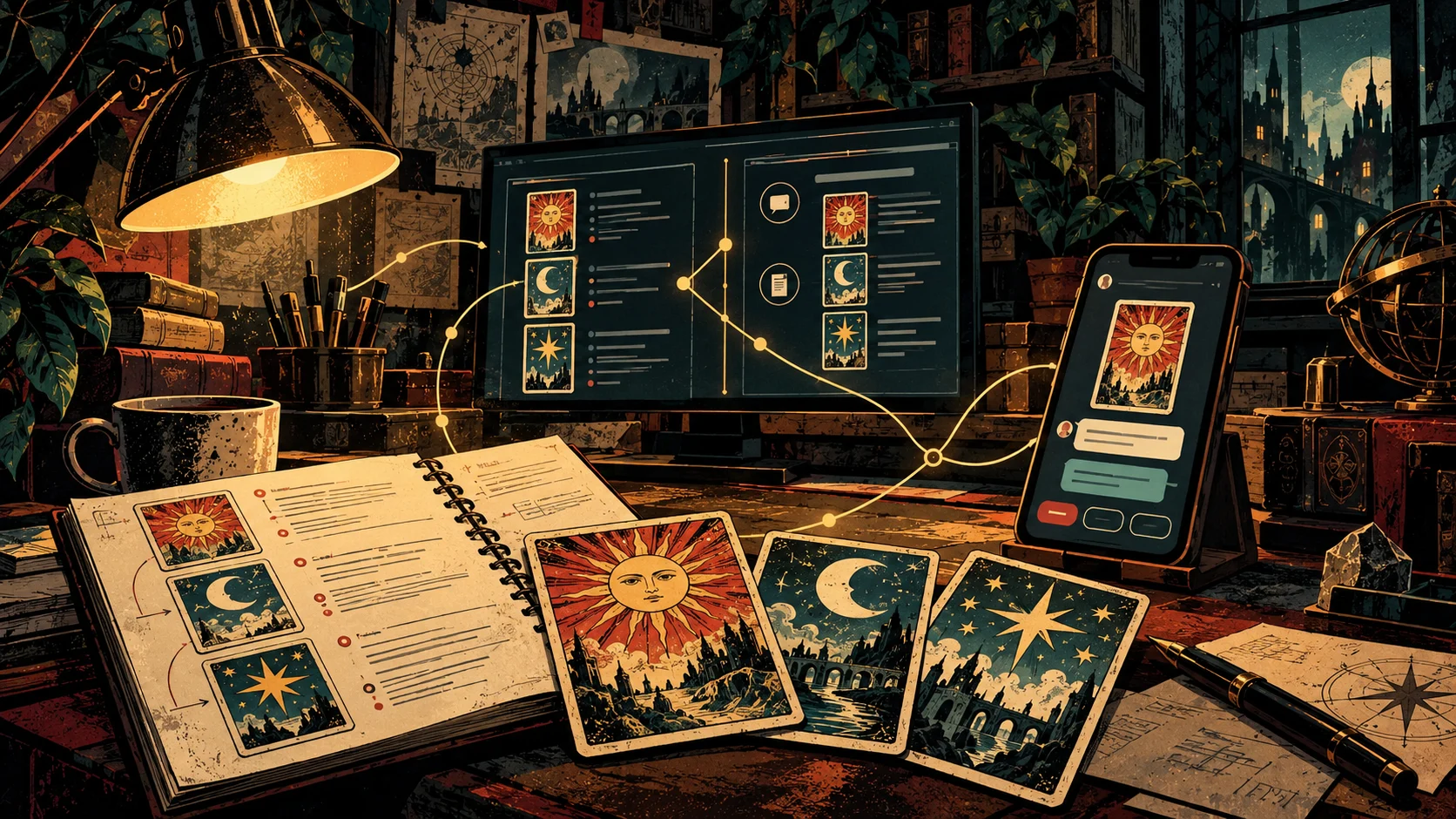
About two years ago, I discovered the Notion API.
By then, I’d already spent several years keeping pretty much my whole life in Notion: tasks, plans, and a personal journal. Finding out I could build something on top of it immediately made me want to try.
A few people I knew were into tarot. And tarot seemed like an interesting fit for the experiment: established card meanings, familiar spreads, and plenty of descriptions available online.
What if I put that material into Notion pages and gave an AI access to the database?
Notion as the control panel
The idea was to generate readings from content that a person could easily edit. Someone without any development experience could adjust the descriptions, change the wording, or add their own interpretation without touching the code.
The database could hold descriptions in the language they wanted. They could swap out the card images. The same basic setup could become someone else’s tarot bot.
I even thought it might be fairly easy to sell as a white-label solution: give someone the bot and a familiar place to manage its content, then let them make it their own.
That was part of what appealed to me about Notion. I already liked using it for myself, and here it looked like a practical editing interface for someone who would never want to open a code editor.
I also wanted to try building a proper Telegram bot. I’d made Mini Apps before, but those had mostly been simple web apps wrapped for Telegram. This time I could experiment with buttons, a conversation flow, and even monetization inside the bot.
So I built the first prototype of Father Tarot. I played with it, gave it to some friends, and then forgot about the project for two years.
A quiet weekend, two years later
Later, I got to know Cloudflare and PixiJS. One weekend I was bored and decided to revisit the bot.
With those tools, I could give it a much nicer visual experience. I updated the AI model too, and made the whole thing work more reliably.
I like what it’s become. An experiment I put aside for two years has grown into a small personal project that I enjoy coming back to.
Letting two projects work together
A couple of weeks ago, I wanted to try a collaboration between my own projects and test them along the way.
I created two Telegram channels about tarot, one in Russian and one in English, and used Signailist to automate publishing tarot posts and readings to them.
To connect the projects, I wrote an API for Father Tarot that serves card images from Cloudflare R2 along with their descriptions.
The readings themselves are generated on the Signailist side, using the same AI model as the bot: GPT-6 Luna. Father Tarot supplies the card material; Signailist uses it to prepare and publish the posts.
At first, I thought I should expose a reading-generation endpoint too. Signailist could just ask the bot for a finished reading.
But the more I thought about it, the less comfortable I was with that split.
The API I decided to leave out
The bot already has its own monetization. If I exposed the part that generates readings, I’d need to decide how access to it should be paid for.
That would mean turning it into a paid API, with Signailist paying Father Tarot for the readings it requested.
Suddenly, a small integration between two of my projects was turning into a separate task involving an API gateway and billing between services. Signailist isn’t ready for that yet.
So I kept the integration at the level I actually needed: images and descriptions from Father Tarot, generation and publishing in Signailist.
Now each channel gets around 14 different posts a week. Signailist first generates a post in Russian along with an image, then creates the English translation and publishes both versions to their respective channels: @fathertarot_ru and @fathertarot_en.
I’m not entirely sure why I enjoy watching this so much, but I like seeing my products work. Especially when they’re working together :)
You can try Father Tarot on Telegram or take a look at Signailist, which handles the publishing side of this experiment.